
Debt collection for LBO & high-growth companies
Secure your cash-flow with CashNow
Under an LBO, every euro of cash comes at a price. Debt service does not stop because a client pays late. And in a hypergrowth company, accounts receivable grows faster than the processes built to manage it.
In both contexts, DSO is not just another KPI. It is a variable that directly dictates your ability to meet bank covenants, stick to the business plan presented to investors, and fund growth without drawing further on your cash reserves.
CashNow structures accounts receivable management for CFOs who cannot afford to wait until cash flow problems become visible too late.
Why accounts receivable management changes under an LBO or in hypergrowth

Debt service demands uncompromising cash discipline
An LBO structure relies on debt scaled around the company’s ability to generate cash. Bank covenants impose strict ratios to meet, quarter after quarter. A slip in DSO that degrades working capital can easily put these ratios under pressure, long before the P&L shows any sign of weakness.
Accounts receivable management then becomes a matter of financial governance, closely monitored by the private equity sponsor, not just a job for the collection team.
Rapid growth outpaces processes
In hypergrowth, the volume of clients, invoices, and outstanding balances grows faster than the organization can keep up. Collection workflows that worked for 200 invoices a month break down at 2,000. Excel spreadsheets that were once enough become a source of risk: missed follow-ups, duplicates, and a lack of consolidated visibility over real exposure.
The result is a silent deterioration of DSO, until the issue escalates to the executive committee as a cash crunch.


Investor reporting requires reliable data, delivered fast
Under an LBO, monthly or quarterly reporting to the sponsor systematically includes tracking working capital, DSO, and portfolio quality. Producing these metrics manually by consolidating multiple files or entities takes time and introduces room for error right when precision matters most.
An LBO CFO needs to generate these figures in a few clicks, not rebuild them at every reporting deadline.
Multiple entities complicate the consolidated view
M&A, new subsidiaries, group structuring: LBO or high-growth companies quickly operate across several legal entities. Each comes with its own client portfolio, and sometimes its own ERP. Without consolidation, the CFO manages a fragmented view of credit risk and overall exposure, right when a complete picture is essential.

What CashNow brings to LBO & hypergrowth CFOs
A measurable reduction in DSO, with a direct impact on available cash
CashNow structures collection workflows, automates their trigger points, and eliminates the missed follow-ups that naturally extend payment terms. Every day of DSO gained translates directly into available cash, to service debt or finance growth without relying on additional external funding.
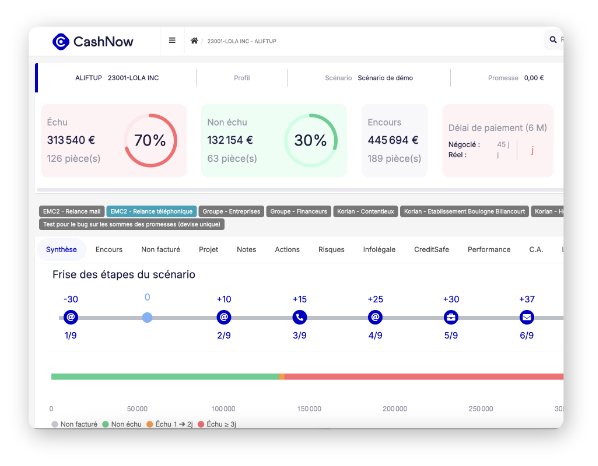
Consolidated reporting ready for investor deadlines
The CashNow dashboard centralizes metrics such as DSO, outstanding receivables, aged trial balance, and the impact of collection efforts on receipts. It provides a consolidated multi-entity view if your structure requires it. Your receivable KPIs are available continuously, not reconstructed on the eve of every board meeting.
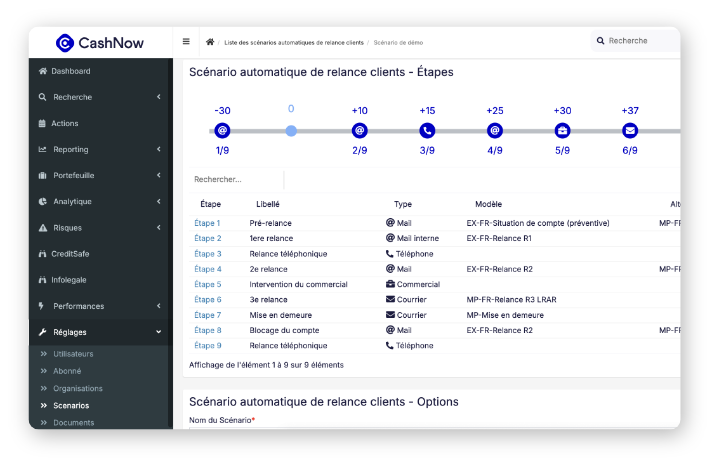
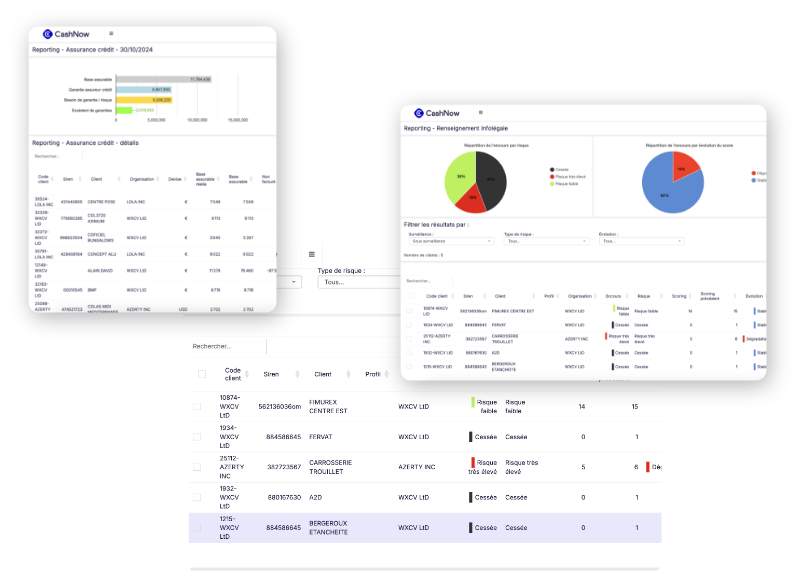
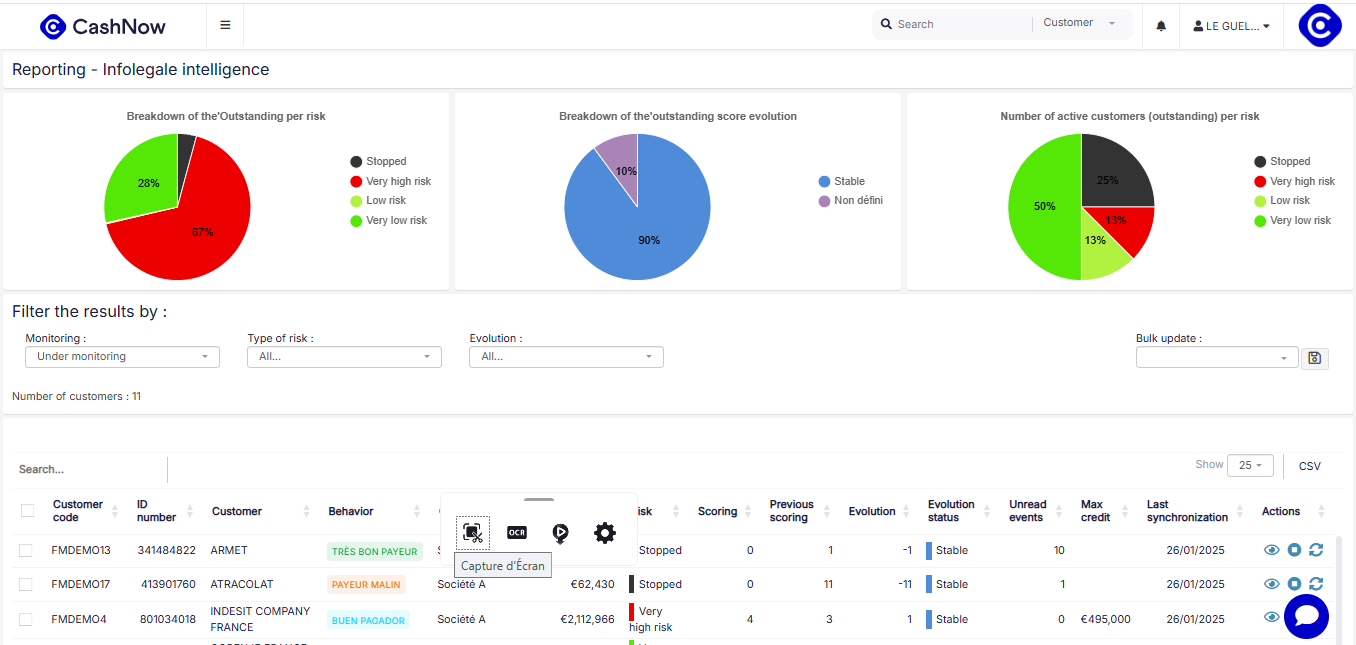
Structured credit risk management, not a DIY approach
CashNow allows you to set credit limits per client, monitor risk trends over time, and trigger automatic actions based on your business rules (DSO overruns, high balances, shifts in payment behavior). Growing your client portfolio no longer means losing control over risk.
A tool that scales with volume, without restructuring your teams
Whether your company grows from 500 to 5,000 monthly invoices, CashNow absorbs the extra workload without requiring you to hire at the same pace. Automated follow-ups and centralized client communications keep DSO under control, even when volume doubles in a few quarters.
Dispute management that stops freezing full balances
An invoice dispute should never delay payment on the rest of a client’s balance. CashNow isolates disputed amounts, secures payment for the undisputed portion, and structures the resolution workflow without bogging down the CFO on individual cases.
CashNow: a collection software solution built for financial performance
Beyond the LBO or hypergrowth context, CashNow is a complete collection software solution: automated payment reminders, credit risk management, dispute handling, reporting, and DSO monitoring. A platform built for CFOs who want to transform accounts receivable into a performance driver, rather than treating it as an administrative burden.
Want to structure your credit management ahead of your next investor committee?
Fill out the formInformation request
FAQ : Debt collection for LBO and high-growth companies
Why is DSO monitored so closely in an LBO context?
Because DSO directly impacts working capital, and working capital dictates the company’s ability to comply with debt-related bank covenants. A rising DSO reduces the cash available for debt service, which can put financial ratios under pressure before operational performance is even questioned.
How do you structure collections when invoice volume surges?
The key is automating routine tasks before volume exceeds your team’s manual capacity. CashNow lets you set up self-running collection workflows, reserving human intervention for complex cases or key accounts. This absorbs volume growth without letting DSO slip.
How can you produce reliable DSO reporting for an investor board?
Reporting must rely on consolidated data that updates continuously, rather than being compiled manually before each deadline. CashNow centralizes DSO, outstanding balances, and aged trial balances into a dashboard accessible at any time, complete with multi-entity views for groups with several companies.
Does CashNow work for companies managing multiple legal entities?
Yes. CashNow lets you connect multiple entities, view data individually or consolidated, and manage user permissions accordingly. This is a common setup for groups built through M&A or structured under an LBO.