
Construction debt recovery
Manage your receivables, retainage, and subcontractiong and secure your cash flow, project by project
In the construction industry, financial risk doesn’t end with delivery. Between 12-month retainage blocks, extended payment terms from project owners, and unpaid debts moving up the subcontracting chain, a construction company’s cash flow is under constant pressure.
According to industry data, over 60% of companies in this sector are affected by late payments. This means that working capital requirements are structurally strained, and business failures are often linked not to a lack of orders, but to a lack of cash.
CashNow offers a recovery solution tailored to the specificities of the construction sector, helping you turn your receivables into cash without waiting for the project’s end.
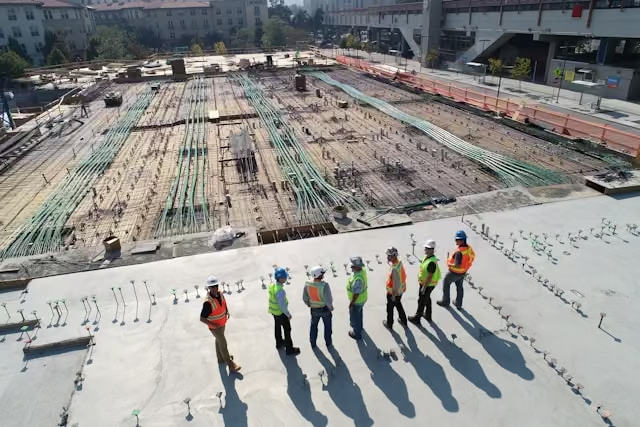
The challenges of debt recovery in construction
Construction combines several factors that complicate debt management. Projects span months, sometimes years. Interim invoices are issued progressively, disputes often arise at the end of a project, and retainage is only released after all defects are cleared. Without a dedicated tracking tool, these receivables accumulate, get lost in spreadsheets, and weigh heavily on your working capital.
Additionally, the contractual complexity unique to the sector—public contracts, private contracts, subcontracting agreements, direct payments—means every setup has its own legal rules and deadlines.
Legal payment deadlines in construction
Knowing the legal deadlines is the first step in defending your rights. In construction, these vary depending on the type of contract.
Private contracts:
Payment terms cannot exceed 45 days end-of-month or 60 days from the invoice date. For work contracts with a verification period agreed upon by both parties, this period can be reduced to 30 days after the end of the month in which the work was performed.
Public contracts:
Deadlines are stricter: 30 days for the State, public establishments, and local authorities. Note: Public health establishments benefit from an exceptional 50-day deadline. Any delay automatically entitles you to late payment penalties and a fixed recovery indemnity of at least €40, without a reminder being necessary.
Payment guarantees specific to construction
Specific mechanisms exist to secure payments for construction companies. Knowing them is the first step toward protection.
Payment guarantee
For private work contracts exceeding €12,000, the project owner is required to provide a payment guarantee. This can take the form of a joint guarantee, an autonomous first-demand guarantee, or a payment delegation. In the absence of this guarantee, you can legitimately suspend work after a formal notice remains unanswered for 15 days.
Contractor's lien
Artisans, workers, and subcontractors involved in a building’s construction have a direct action claim against the project owner, up to the amount still owed to the main contractor. This is a powerful and often underused lever to bypass a main contractor’s failure.
Performance bonds
Some public contracts require the company to provide a performance bond. Conversely, as a private contract holder, you can demand a payment bond from your private project owner. CashNow helps you identify contracts where this lever can be activated.
Retainage: Stop letting your 5% sit idle
Track every retention project by project
Retainage represents 5% of the pre-tax amount of each interim invoice, held for 12 months after the project’s handover. Legally regulated, it is often released too late or simply forgotten by both parties.
CashNow allows you to track all your ongoing retainage in real-time, with scheduled release dates and associated amounts.
Anticipate release requests
Rather than passively waiting for the project owner to release the funds, CashNow automatically triggers a reminder as the due date approaches. It is sent to the right contact, and every step is traced.
Use a bank guarantee instead of retainage
Certain contracts allow the replacement of retainage with a bank guarantee (bond), immediately freeing up your cash flow.
Subcontraction: secure the entire payment chain
As a General Contractor: Master your obligations
As the lead contractor, you have a legal obligation to pay your subcontractors within the terms set in the contract, regardless of whether the project owner has paid you.
As a Subcontractor: Assert your rights
Specific subcontracting laws give you strong rights: direct payment by the project owner in case of general contractor failure, and mandatory bonds for public contracts. CashNow helps you immediately identify invoices eligible for direct payment and adapt your reminder strategy accordingly.


One client, multiple projects
In construction, one accounting client can represent several simultaneous projects, each with different progress levels, interim invoices, and deadlines. Reminding at the account level without distinguishing projects leads to confusion and unnecessary disputes.
The CashNow Project/Business Management module allows you to manage each project as a distinct entity while maintaining a consolidated view per client. Each business has its own outstanding balance tracking, tailored reminders, and history—even when everything links back to the same accounting ID.
[Learn more about the Project/Business Management module]
Learn more about the Project/Business Management module
Manage end-of-project disputes
In construction, disputes are usually administrative and occur at the end of a project regarding specific issues: unrecorded defect clearance, contested Final General Accounts (DGD), unsigned handover certificates, unvalidated quotes for extra work, or late penalties applied by the project owner.
CashNow allows you to identify and qualify the exact cause of each dispute to adapt your follow-up. This avoids confusing a bad-faith non-payment with an administrative block that can be resolved with a simple document.
Read also:
Public vs. Private Contracts: Two recovery logics
Public construction contracts:
Authorities and the State are solvent clients, but their validation circuits can be long. CashNow monitors your public receivables and triggers reminders adapted to each public owner’s payment workflow.
Private construction contracts:
Developers, private landlords, and industrial firms have their own practices. CashNow automatically segments your clients according to their payer profile and adapts the tone and schedule based on their history.
CashNow: A recovery solution designed for construction
Construction doesn’t need a generic reminder tool. It needs a solution that understands project logic, subcontracting complexity, and retainage specificities.
With CashNow, your teams can:
> Track all retainage with automatic alerts upon maturity.
> Manage subcontractor and lead contractor receivables on a single interface.
> Segment reminders between public and private markets.
> Centralize project disputes for faster resolution.
> Reduce DSO and improve working capital.
Want to secure your cash flow project by project? [Contact us for a personalized demo]
FAQ: Construction debt recovery
What is retainage in construction?
Retainage is a sum held by the project owner on each interim invoice, representing 5% of the pre-tax amount. It guarantees the proper execution of work for 12 months after handover. It must be returned upon expiry of this period, except for unresolved defects.
What are the legal payment deadlines in construction?
For private contracts, the maximum is 45 days end-of-month or 60 days from the invoice date. For public contracts, it is 30 days for the State and local authorities, and 50 days for public health establishments.
Can a subcontractor be paid directly by the project owner?
Yes, under specific laws (such as the 1975 Act in France), an approved subcontractor can request direct payment from the project owner if the general contractor fails to pay. This is mandatory for public contracts.
How do I manage end-of-project disputes without blocking payment?
The key is to separate undisputed amounts from disputed sums. You can demand payment for the undisputed part while opening a resolution procedure for the contested portion. CashNow allows for this distinction on a project-by-project basis.