
2026 e-invoicing: Why it’s excellent news for your cash flow
Everyone is talking about it as a legal constraint, a deadline to meet, or an administrative headache. Yet, the e-invoicing reform hides a revolution that is far more interesting for businesses: a total transformation of accounts receivable management.
While the law changes how you send your invoices, it will primarily change how fast the money hits your bank account. Here is how.
The 2026 e-invoicing reform: A quick brief
Electronic invoicing is a major initiative by the DGFIP (French Directorate General of Public Finances) to modernize French businesses. The reform will be rolled out progressively starting September 1, 2026 (mandatory reception for all companies, and mandatory issuance for Large and Mid-sized Enterprises). Eventually, paper invoices and simple PDFs sent by email will completely disappear from B2B exchanges.
To ensure document authenticity, every invoice must now pass through a trusted third party. Contrary to initial announcements, the French government has updated the framework: businesses will now be required to use Plateformes Agréées (PA) (Authorized Platforms, a term that replaces the former PDP).
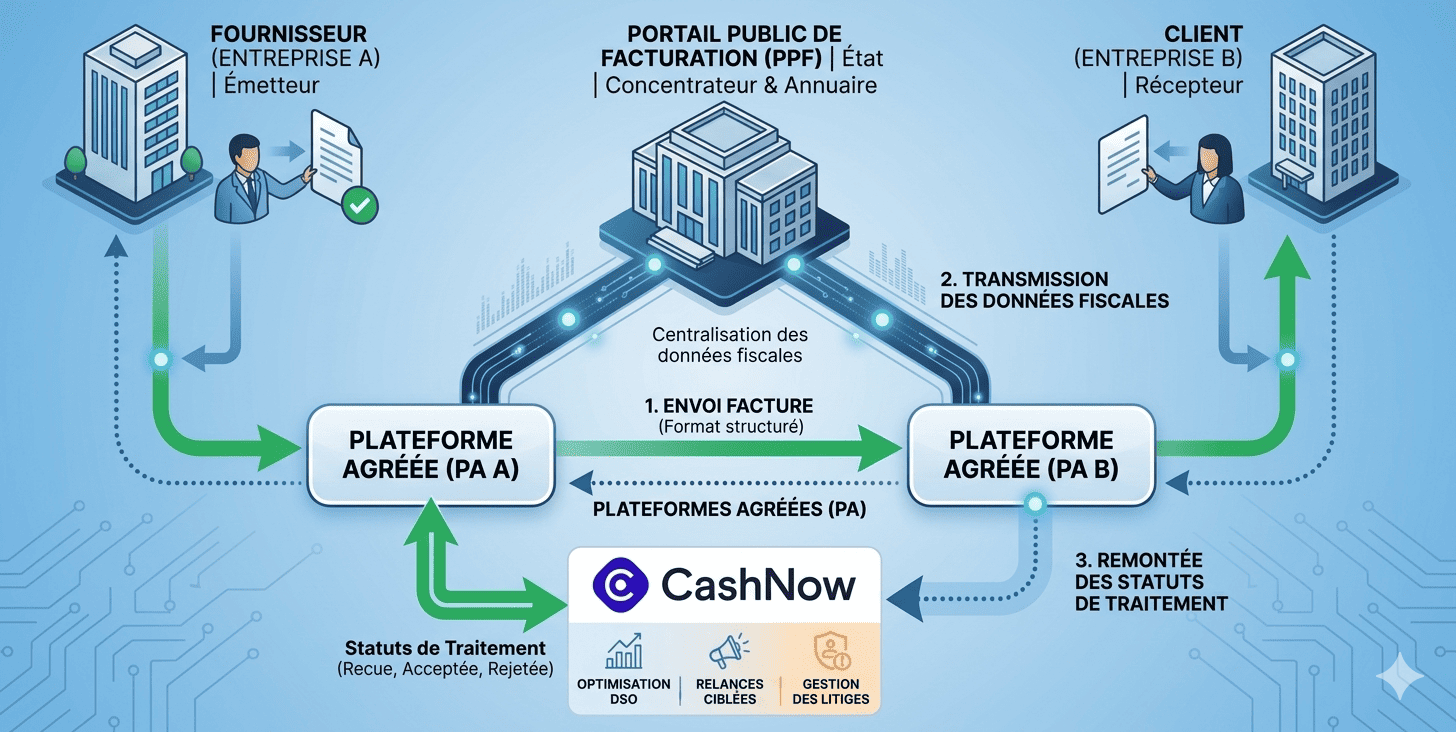
The Portail Public de Facturation (PPF) will no longer serve as a direct invoicing platform for businesses. Its role is now centered on two critical missions:
-
Data Hub (Concentrateur de données): It centralizes tax data extracted from invoices and payment data to transmit them to the tax administration.
-
Central Directory Management: It manages the official registry of the reform’s participants to guarantee the correct routing of flows.
To simplify these exchanges, the state has defined a standardized architecture known as the “Y-flow.”
Here is the secure path of an invoice tomorrow:
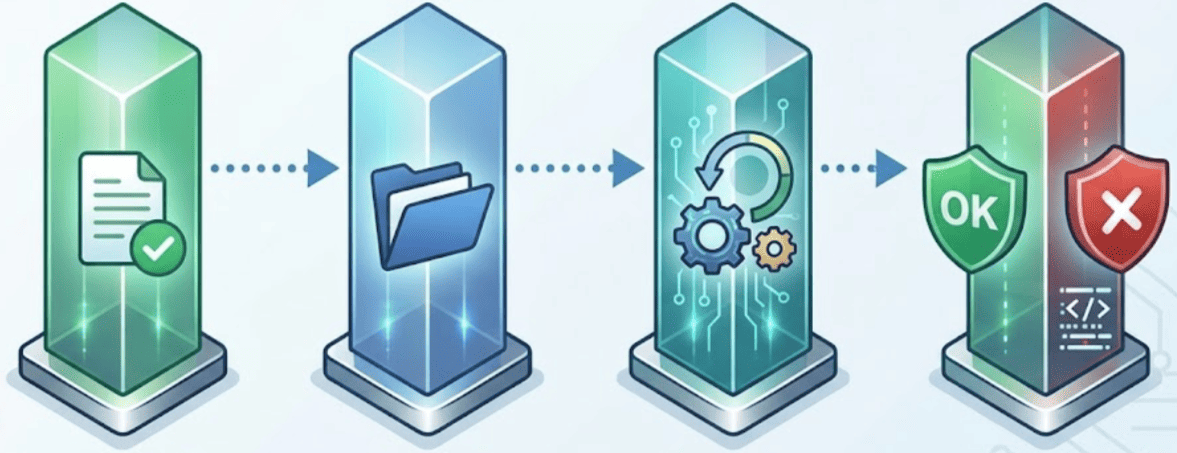
1. Issuance:
Company A generates its invoice via its management software, which automatically sends it to its Plateforme Agréée (PA).
2. Control and validation:
The PA verifies that the invoice contains all mandatory information and follows a structured format. Once validated, it digitally seals the document.
3. Transmission:
The platform transmits the invoice to the client’s platform (Company B). Simultaneously, it is mandatory to transmit essential data to the PPF for the tax authorities.
4.Reception:
Company B receives the valid invoice in a structured format, directly integrated into its own software or Plateforme Agréée (PA), ready for payment.
This architecture ensures that the state collects VAT more efficiently, but more importantly, it ensures the document is tamper-proof and transmitted without formatting errors.
The invoice “black hole” is coming to an end!
Until now, debt collection has suffered from one major issue: a lack of information. Once an invoice was sent, it was radio silence.
Has the invoice been received ? It is blocked due to an entry error ? Is it scheduled for payment ?
Usually, you only found out during a follow-up call 30 days later. E-invoicing changes the game by introducing the invoice lifecycle, inspired by what the public sector already does with the Chorus Pro portal.
The added value: real-time processing status
This is the true lever for your cash flow. With e-invoicing, you will retrieve real-time processing statuses:
- Submitted
- Received
- Processed
- Approved or Rejected (with a specific reason code)
For a collection department, this is a goldmine. If an invoice is rejected due to a coding error, you know instantly. You no longer wait for the due date to act. Your accounts receivable management becomes surgical, resolving disputes before they even turn into late payments.
CashNow: accounts receivable software ready for tomorrow
Technology facilitates exchange, but it doesn’t eliminate human errors within a company. This is where your choice of collection software comes in. The challenge of tomorrow for high-performance collection software is the ability to connect to these platforms to pull these crucial statuses.
At CashNow, our goal is to integrate these flows to make your reminders even smarter:
- If the status shows a “Rejection,” the reminder workflow adapts immediately to correct the error.
- If the status is “Approved,” your cash flow forecast finally becomes 100% reliable.
In short, DSO optimization will no longer be about “brute force” follow-ups, but about data intelligence.
Prepare your cash flow now
E-invoicing and debt collection are now inseparable. By automating your flows, you reduce disputes and accelerate your cash inflows.
Are you still using manual processes? It’s time to switch to modern debt management. Discover how a reform-compliant collection software can transform your daily operations.